Design Thinking Index for Educators
How much of a design thinker are you in class?
24 quick questions, 7 minutes. See where you already think like a designer, and one thing to try on Monday.
- ~7 min
- 24 questions
- Grade K-12 teachers
- Instant report
- English





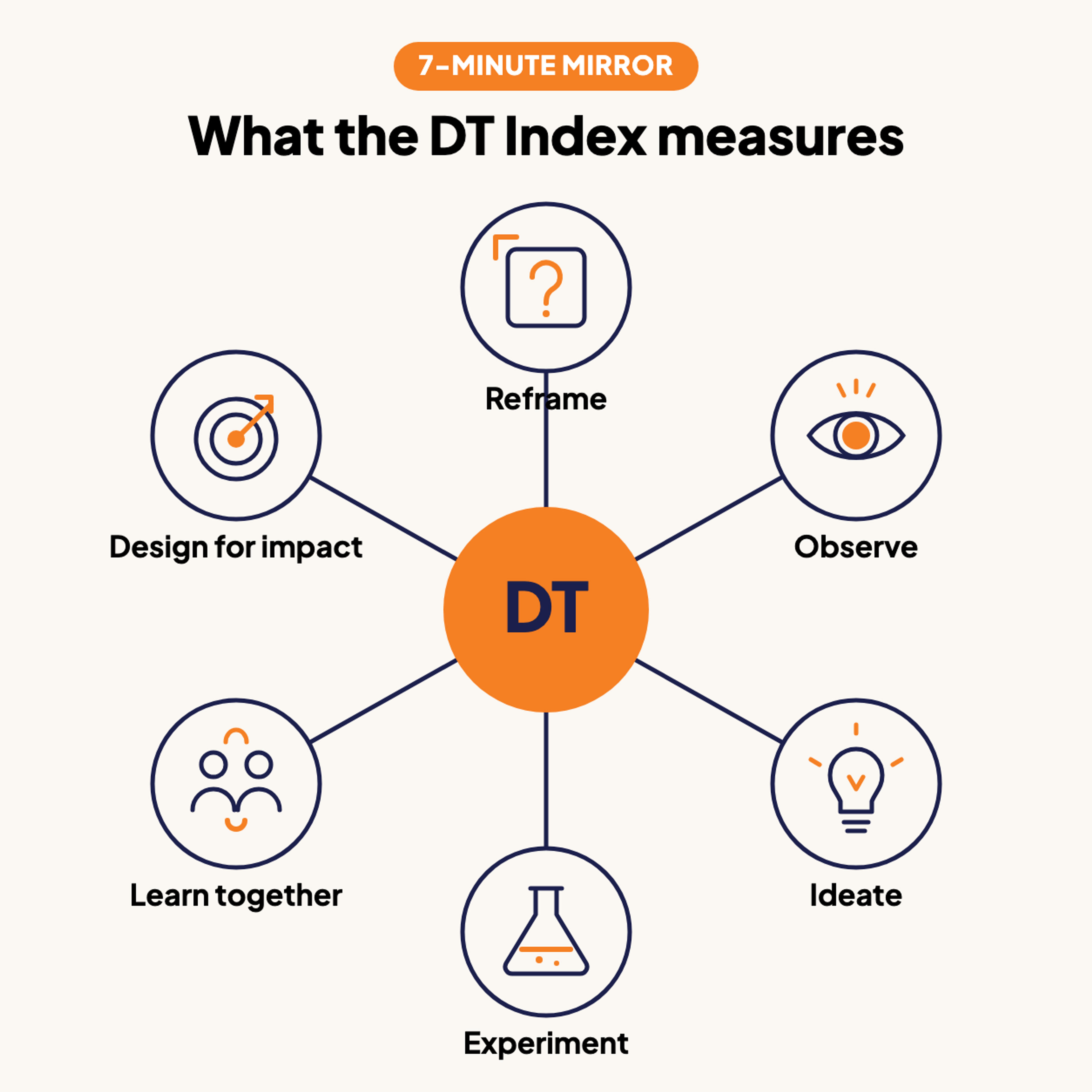
The Six Habits, In Plain Words
Each habit is read from three frequency statements and one classroom situation. Your result shows where you stand on each, in a fixed order so profiles can be compared over time.
Reframe
Checks whether the named problem is the real problem before acting. Asks what is underneath a symptom.
- what is underneath
- symptom vs cause
- the problem in one line
Observe
Separates what was seen from what was assumed about a student before designing a response.
- seen vs guessed
- how it felt from their side
- what it looks like to them
Ideate
Generates several options before choosing; is willing to voice an unusual idea.
- several ways before one
- the unusual idea
- not the same as last year
Experiment
Tries a small version first, decides what to watch, and adjusts. Comfortable when the outcome is uncertain.
- small change, one lesson
- decide what to watch
- comfortable when unsure
Learn together
Uses colleagues and students' mistakes as information; treats a failed lesson as data.
- a colleague from another subject
- a lesson that misses is information
- students' mistakes
Design for impact
Builds a real reason for students to need the content; believes small teaching changes change student behaviour.
- a real reason to need it
- small change, big effect
- end in something made or decided
How It Works
Tell us about your teaching.
Grades you teach, main subject, years in the classroom. Used for norms, never shown on your result.
Answer honestly.
18 statements: tap how often this is true for you. 6 classroom situations: tap what you would actually do, not what sounds best.
Verify your email.
A quick 6-digit code, so your result reaches your inbox and stays yours.
Read your Monday action.
Your six-habit profile, your strength, your next step, and one thing to try in one lesson next week.
Who Is It For?
- School teachers across CBSE, ICSE and state boards who want an honest read on how they already teach
- Coordinators and principals who want a school-level picture of design thinking in classrooms
- Schools planning the 3-hour Design Thinking for Educators workshop, before and after the session
- Teachers with seven minutes and a real class problem on their mind
Why it is worth it
Most tests hand back a score. You walk away with a clear read on how you are wired, and the one thing worth working on next.
Personalised, generated the moment you finish, and yours to download as a PDF. Not a label. Something you can actually act on.
Inside Your Report
- Your Design Thinking Index (0 to 100) with a band name
- Your six-habit profile: Reframe, Observe, Ideate, Experiment, Learn together, Design for impact
- Your strength and your next step, in plain words
- One thing to try on Monday, in one lesson
- An instant on-screen result, with a copy delivered to your inbox
Common Questions
Is this a test?
No. It is a mirror: a 7-minute self-report that shows how often you already use six design thinking habits in class. There are no right answers, no pass mark, and no ranking of teachers.
How long does it take?
About 7 minutes. 18 quick statements and 6 short classroom situations, one per screen, with no time pressure.
Who is it for?
K-12 school teachers across CBSE, ICSE and state boards, and the coordinators and principals who want a school-level picture. Schools use it before and after the 3-hour Design Thinking for Educators workshop.
Is it validated?
The six habits follow the Design Thinking Mindset scale of Vignoli, Dosi and Balboni (2023), collapsed to six teacher-facing habits and reworded for classroom behaviour; item wording is original. The index itself is new and its bands are provisional until it has been calibrated on teacher data. It is not a validated diagnostic or a certification.
What happens after?
Your result appears on screen the moment you finish, with a copy in your inbox. Read the Monday action first: it is one small change in one lesson. If your school wants to try this together, the 3-hour Design Thinking for Educators workshop is the next step.
How much of a design thinker are you in class?
24 quick questions, 7 minutes. See where you already think like a designer, and one thing to try on Monday.
Six habits, each read from three statements and one classroom situation. You get an overall index with a band name, a six-habit profile, one strength, one next step, and one thing to try on Monday. Not a ranking of teachers.
Built for teachers, not managers
No right answers.
Your result is private.
Built for teachers, not managers.
Grounded in the Design Thinking Mindset scale of Vignoli, Dosi and Balboni (2023), reworded for classroom behaviour. Bands are provisional until the index is calibrated on teacher data.
A mirror, not a test.
Seven minutes, 24 questions, and one honest look at how you already teach. Your result appears the moment you finish. It is free.