EmotionLens
Find out your emotional intelligence, and the one area to build next.
Your best friend goes cold and will not say why. The class laughs at the wrong moment and your face goes hot. A teammate is clearly upset and you have no idea what to say. Marks never measure any of this, yet it shapes almost every day at school. EmotionLens is a mirror for your emotional intelligence: how you notice what you are feeling, read what others are feeling, and steady yourself when it matters most. In about twenty honest minutes you see where your emotional skills already carry you, and the one worth growing next.
- 20 min
- 30 questions
- Grade 8-12
- Instant report
- English





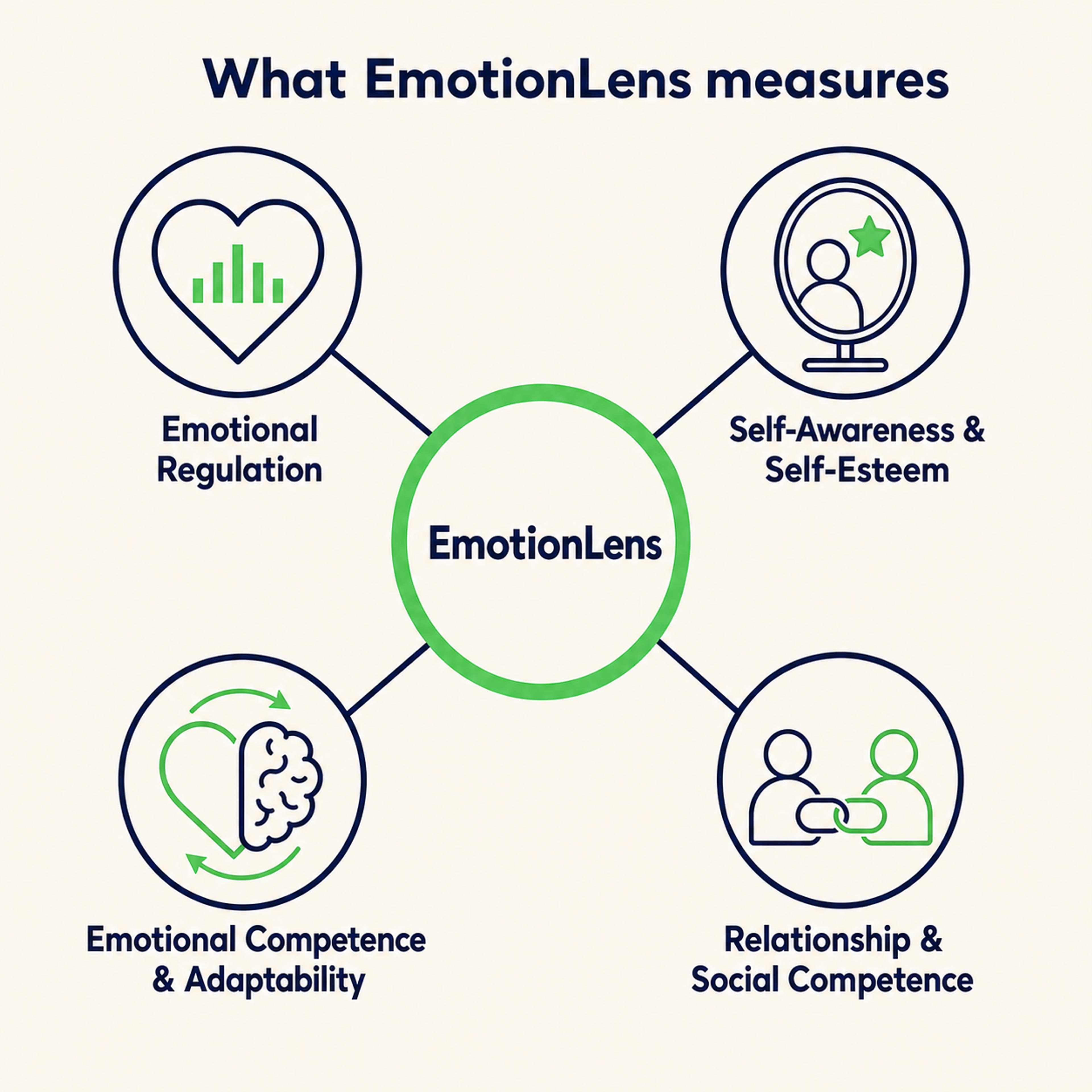
What It Measures
Four areas that shape your emotional intelligence: how you regulate strong feelings, how clearly you see yourself, how you adapt when things change, and how you handle relationships.
Self-Awareness
You catch the nerves or frustration rising in you and name it, instead of only noticing after you have snapped or gone quiet.
Empathy
You pick up on the friend who says they are fine but clearly are not, and you sense what people feel even when they never say it out loud.
Adaptability
When a moment turns tense or a plan falls apart, you choose how to respond instead of letting the first rush of emotion decide for you.
Communication
You say the hard thing kindly, read the room, and use tone and timing so people actually take in what you mean.
Motivation
You turn how you feel into fuel, letting a setback or a spark become a reason to keep going rather than a reason to stop.
How It Works
Work through 30 scenarios.
Read each real-life situation and pick what you would actually do.
Verify your email.
A quick 6-digit code so we can send your report and keep it yours.
Get your EmotionLens score.
An instant on-screen report with your four emotional-intelligence areas.
Turn it into a plan.
Optional free conversation with a Stride mentor.
Who Is It For?
- You are in Class 8 to 12 and feel things deeply, and you want to understand your own reactions instead of being caught off guard by them.
- A friendship or a group just got complicated, and you want to handle the next hard conversation better than you handled the last.
- You are often the calm one people come to, and you want to see how strong that emotional read of yours really is.
- You are a parent, counsellor, or teacher who wants an honest picture of how a student notices and handles emotions, their own and other people's.
Why it is worth it
Most tests hand back a score. You walk away with a clear read on how you are wired, and the one thing worth working on next.
Personalised, generated the moment you finish, and yours to download as a PDF. Not a label. Something you can actually act on.
Inside Your Report
- Your EmotionLens score (0 to 100) and where you sit across four emotional-intelligence areas
- Your real strengths in plain language you can use this week
- A clear view of your weakest area, and what to build there first
- A growth plan of concrete habits, not a generic checklist
- An instant on-screen report, with a copy delivered to your inbox
Common Questions
How long does the test take?
~8 minutes. 30 real-life scenarios, no time pressure, so pick what feels honest.
When do I receive the report?
Instantly. Your personalised report appears on screen the moment you finish, and a copy lands in your email.
Who built this?
Built in-house by Stride Ahead: a 30-scenario emotional-intelligence test across four areas, designed on established assessment principles and refined with expert input.
Can I retake the test?
Yes, any time, and it is free. Retake it after a few months to see how your emotional intelligence has grown.
Ready to see your emotional intelligence?
Take EmotionLens. It takes about 8 minutes, and your personalised report is generated the moment you submit, ready to download as a PDF. It is free.