Interpreter
Also known as: language mediator, language specialist, communication bridge
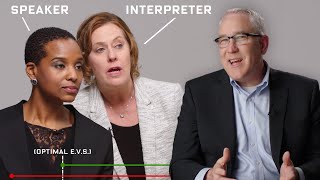
As an interpreter, you'll be the bridge between people who don't speak the same language. You'll listen carefully to someone speaking or signing in one language and then accurately relay their message in another language, making sure the meaning, tone, and style are all perfectly captured. This could happen in real-time, like during a conference, or after someone has spoken, like in a meeting. You might also help people understand written information by reading it aloud in a different language. Your goal is to make communication as smooth as if everyone spoke the same language.
10
Skills to Learn
4
Career Levels
6
Top Companies
2
Education Paths
Sneak Peek
Do you love understanding different languages and cultures? Could you imagine yourself helping people connect and communicate when they speak different languages?
What does an Interpreter do?
You'll be the bridge between people who don't speak the same language. You'll listen carefully to someone speaking or signing in one language and then accurately relay their message in another language, making sure the meaning, tone, and style are all perfectly captured.
- Salary in India
- ₹3.5 to ₹8.5 lakh a year
- Demand
- Stable
- Remote work
- Hybrid
- Industry
- Interpreting and Translation
Is This Career For You?
Discover if your personality matches this career
Your Personality Fit (RIASEC)
Thrive on helping others communicate and bridging cultural divides.
Enjoy analyzing complex linguistic information and understanding the nuances of language.
Appreciate the artistic and expressive aspects of language and communication.
Can be driven to take initiative in communication and manage interactions.
Benefit from structured processes in managing information and adhering to professional standards.
May enjoy hands-on application of language skills but less focused on physical tasks.
You'll Love This Career If...
Like what you see? Get full access.
Save this career, compare with others, and get your personalized career plan.
50,000+ students already signed up
A Day in the Life
What your typical workday looks like
Your day could involve anything from helping a doctor understand a patient's symptoms in a hospital to interpreting for a business team during an international negotiation. You might be in a courtroom one day, a school the next, or even working remotely connecting people through video calls. You could be interpreting simultaneously, speaking at the same time as the original speaker, or consecutively, relaying the message after the speaker pauses. You might also do "sight translation," where you read a document in one language and say it in another.
Myth vs Reality
Tap to reveal the truth behind common misconceptions
Skills You'll Need
Master these to excel in this career
Technical Skills
3Deep Linguistic Expertise
Proficiency in at least two languages, including one at a native or near-native level.
Technical Proficiency
Familiarity with Computer-Assisted Translation (CAT) tools and localization platforms.
Research Skills
Capability to verify terminology and understand domain-specific concepts.
Soft Skills
7Cultural Understanding
Awareness and sensitivity to cultural nuances and differences.
Attention to Detail
Ability to identify and correct subtle linguistic nuances and inconsistencies.
Adaptability
Flexibility to adjust to new tools, evolving standards, and diverse client requirements.
Problem-Solving
Skill in resolving linguistic ambiguities and navigating complex terminology.
Time Management
Ability to meet strict deadlines while maintaining high quality.
Client Empathy
Understanding of client needs and expectations for effective solutions.
Collaboration
Effective teamwork with project managers, engineers, and other specialists.
Tools of the Trade
Software and tools you'll work with daily
Hardware
Headset and Microphone
Essential for simultaneous interpretation, allowing the interpreter to hear the speaker and transmit their interpretation.
Soundproof Booth
A quiet environment critical for simultaneous interpreters to focus and deliver accurate interpretations.
Software
CAT Tools (e.g., Wordscope)
Computer-Assisted Translation tools that help manage terminology, improve consistency, and boost productivity, often integrating with AI.
AI Prompting Tools (e.g., ChatGPT, Gemini)
Used for quick lookups, glossary creation, and understanding AI-assisted translation workflows.
Platform
Glossaries and Terminology Databases
Custom-built or professional databases used to ensure accurate and consistent use of specialized terms.
Video Conferencing Platforms (e.g., Zoom, Teams)
Platforms used for remote interpreting, connecting interpreters with clients globally.
Online Dictionaries and Lexicons
Digital resources for quick reference of words, phrases, and their meanings.
Want to build these skills?
Get a personalized learning roadmap and save careers that match your profile.
50,000+ students already signed up
Your Learning Path
Step-by-step guide to getting started
Master Your Languages
Become truly fluent in at least two languages. This involves not just speaking, but understanding grammar, idioms, cultural nuances, and different registers (formal/informal) of each language.
Understand Interpreting Fundamentals
Take introductory courses on interpreting techniques, ethics, and the differences between simultaneous and consecutive interpreting. Learn about cognitive flexibility and memory skills.
Specialize and Practice
Choose a specialization (e.g., medical, legal, technical, humanitarian). Practice interpreting in simulated or real-world settings, perhaps through volunteer work or internships.
Build Your Professional Toolkit
Familiarize yourself with essential interpreting tools, including translation software, terminology management systems, and professional platforms. Network with other interpreters and seek mentorship.
Career Progression
How your career will grow over time
Entry-Level Interpreter
EntryA new interpreter starting their career, learning the basics of the profession.
- Assist senior interpreters in various settings.
- Gain experience in different interpreting modes.
- Build a portfolio of interpreted materials.
Mid-Level Interpreter
Mid-LevelAn experienced interpreter handling more complex assignments.
- Work independently in various settings.
- Specialize in specific fields such as medical or legal interpreting.
- Maintain a professional network and continue education.
Senior Interpreter
SeniorA highly experienced interpreter with a strong portfolio and specialization.
- Take on leadership roles in projects.
- Mentor junior interpreters.
- Contribute to the development of interpreting standards and practices.
Interpreting Manager
LeadershipA leader overseeing interpreting services within an organization.
- Manage a team of interpreters.
- Develop and implement interpreting policies and procedures.
- Ensure quality and compliance with industry standards.
Education Paths
Bachelor's Degree
Post-Secondary Certificate/Diploma
Top Hiring Companies
Salary & Future Growth
What you can earn and where the industry is headed
Salary Progression (INR)
Future Career OutlookCurrent Market: Stable
Employment of interpreters and translators is projected to grow 2 percent from 2024 to 2034, which is slower than the average for all occupations. This means there will be job openings, but the field isn't expanding rapidly.
The demand for interpreters and translators is expected to remain relatively stable over the long term, driven by the need to replace workers who leave the profession and the ongoing need for communication across different languages in various sectors.
While the core need for human interpreters and translators will persist, the increasing capabilities of AI and machine translation may influence the specific types of roles available and the skills required in the very long term.
Not sure if Interpreter is right for you?
Talk to a Stride counsellor for personalised guidance on whether this career fits your interests, strengths, and goals.
Watch & Learn
Curated videos to help you explore




Helpful Resources
Articles and guides for deeper learning
Frequently Asked Questions
Quick answers to common questions
QWhat is the difference between an interpreter and a translator?
Interpreters work with spoken or signed language, converting messages in real-time. Translators work with written text, converting documents from one language to another.
QWhat are the typical education requirements for interpreters and translators?
Typically, a bachelor's degree is required. Proficiency in at least two languages, English and another, is essential, along with expertise in interpretation or translation services.
QWhat are some common work environments for interpreters and translators?
They can work in various settings such as schools, hospitals, courtrooms, and conference centers. Some work is part-time, and schedules can vary.
Explore All 1,500+ Careers
Browse our full career explorer or take an assessment to get personalised recommendations.