Junior Java Developer
Also known as: Java Developer, Software Engineer (Java), Programmer (Java)
A Junior Java Developer is an entry-level programmer who helps build and maintain software using the Java programming language. They work on various parts of applications, from writing code for the server-side logic to helping with database management and ensuring applications run smoothly. Think of them as crucial members of a tech team, learning and contributing to creating the digital tools we use every day.
8
Skills to Learn
1
Career Levels
5
Top Companies
2
Education Paths
Sneak Peek
Have you ever wondered how your favorite apps and websites are built? Do you enjoy solving puzzles and creating things with technology?
What does a Junior Java Developer do?
A Junior Java Developer is an entry-level programmer who helps build and maintain software using the Java programming language. They work on various parts of applications, from writing code for the server-side logic to helping with database management and ensuring applications run smoothly.
- Salary in India
- ₹4 to ₹15 lakh a year
- Demand
- Growing
- Remote work
- Remote-Friendly
- Industry
- Information Technology
Is This Career For You?
Discover if your personality matches this career
Your Personality Fit (RIASEC)
Enjoy analyzing complex problems and finding solutions through logical thinking.
Like working with tools, systems, and practical challenges to build tangible products.
Prefer organized environments and following established procedures to ensure quality.
Can be interested in leading projects and influencing others to achieve goals.
May find satisfaction in collaborating with a team to create software.
Less emphasis, but creativity can be applied to problem-solving and application design.
You'll Love This Career If...
Like what you see? Get full access.
Save this career, compare with others, and get your personalized career plan.
50,000+ students already signed up
A Day in the Life
What your typical workday looks like
Your day might start with a team meeting to discuss what needs to be built or fixed. Then, you'll spend time writing and testing code for a new feature, perhaps learning a new Java tool or framework with guidance from a senior developer. You'll also collaborate with teammates, review code, and help troubleshoot any issues that pop up, all while learning and growing your skills.
Myth vs Reality
Tap to reveal the truth behind common misconceptions
Skills You'll Need
Master these to excel in this career
Technical Skills
4Java Programming
Understanding and ability to write code in Java.
Debugging
Identifying and fixing errors in code.
Understanding of Software Development Life Cycle (SDLC)
Knowledge of the stages involved in software development.
Knowledge of Database Systems
Understanding how to interact with databases.
Soft Skills
4Problem-Solving
Ability to identify, analyze, and solve programming problems.
Team Collaboration
Working effectively with others in a team environment.
Communication Skills
Ability to convey ideas and information effectively.
Adaptability
Ability to adjust to new conditions or environments.
Tools of the Trade
Software and tools you'll work with daily
Software
IntelliJ IDEA
A popular Integrated Development Environment (IDE) for writing and debugging Java code efficiently.
Eclipse
Another widely used IDE that provides a comprehensive environment for Java development.
Maven
A build automation tool used for managing project dependencies and building Java projects.
Gradle
A flexible build automation tool that supports Java projects, often used for its performance and versatility.
Git
A version control system used for tracking changes in code and collaborating with others.
Framework
Spring Boot
A powerful framework that simplifies the creation of stand-alone, production-grade Spring-based applications.
Hibernate
An Object-Relational Mapping (ORM) tool that helps manage database interactions in Java applications.
Platform
SQL Databases (e.g., Oracle, PostgreSQL)
Systems for storing, managing, and retrieving data, essential for most applications.
Docker
A platform for developing, shipping, and running applications in containers, enabling consistent deployment.
Want to build these skills?
Get a personalized learning roadmap and save careers that match your profile.
50,000+ students already signed up
Your Learning Path
Step-by-step guide to getting started
Learn Core Java Fundamentals
Start by understanding the basic building blocks of Java. This includes learning about data types, variables, operators, control flow (if/else statements, loops), and Object-Oriented Programming (OOP) concepts like classes, objects, inheritance, and polymorphism. Practice writing simple programs to solidify these concepts.
Explore Advanced Java & Essential Tools
Dive into more complex Java features such as collections, multithreading, and input/output (IO) streams. Familiarize yourself with Integrated Development Environments (IDEs) like IntelliJ IDEA or Eclipse, and learn how to use build tools like Maven or Gradle to manage your projects.
Understand Backend Development & Databases
Focus on backend development by learning popular frameworks like Spring Boot. Understand how to interact with databases using SQL and ORM tools like Hibernate. Learn about REST APIs for building web services.
Practice, Build Projects & Test
Apply your knowledge by working on mini-projects and then gradually larger ones. Learn about testing frameworks like JUnit and practice debugging your code. This hands-on experience is key to becoming a proficient Java Developer.
Career Progression
How your career will grow over time
Junior Java Developer
EntryBeginner-level developers who work under close supervision to create small features and learn the basics of Java development.
- Design database architecture and server scripting for application integration.
- Research and link to search engines.
- Utilize development tools to make multimedia applications.
- Participate in team meetings to complete application development.
- Troubleshoot production and development issues.
Education Paths
Bachelor's Degree
B.Tech
Computer Science
Post-Secondary Certificate/Diploma
Top Hiring Companies
Salary & Future Growth
What you can earn and where the industry is headed
Salary Progression (INR)
Future Career OutlookCurrent Market: Growing
Java is a highly in-demand programming language, especially for backend systems and large-scale applications. Companies rely heavily on Java, making it a stable choice for a career.
Java's continued use in enterprise environments and its evolution with new features suggest sustained demand. Its versatility across different platforms and applications ensures its relevance in the medium to long term.
While newer technologies emerge, Java's established ecosystem, massive existing codebase, and ongoing updates (like Java 8+ features) indicate it will remain a significant player in the software development landscape for the foreseeable future. Its adaptability to new paradigms will be key.
Not sure if Junior Java Developer is right for you?
Talk to a Stride counsellor for personalised guidance on whether this career fits your interests, strengths, and goals.
Watch & Learn
Curated videos to help you explore

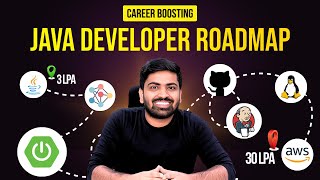


Helpful Resources
Articles and guides for deeper learning
Frequently Asked Questions
Quick answers to common questions
QWhat is Java used for?
Java is used for building a wide range of applications, including web servers, mobile apps (Android), enterprise software, big data processing, and more.
QIs Java hard to learn?
Java has a moderate learning curve. While its syntax is similar to other C-style languages, understanding object-oriented principles and the Java ecosystem takes time and practice.
QWhat are the benefits of being a Java developer?
Java developers are in high demand, often command good salaries, and have opportunities to work on diverse and impactful projects. The language's stability and extensive community support are also advantages.
Explore All 1,500+ Careers
Browse our full career explorer or take an assessment to get personalised recommendations.