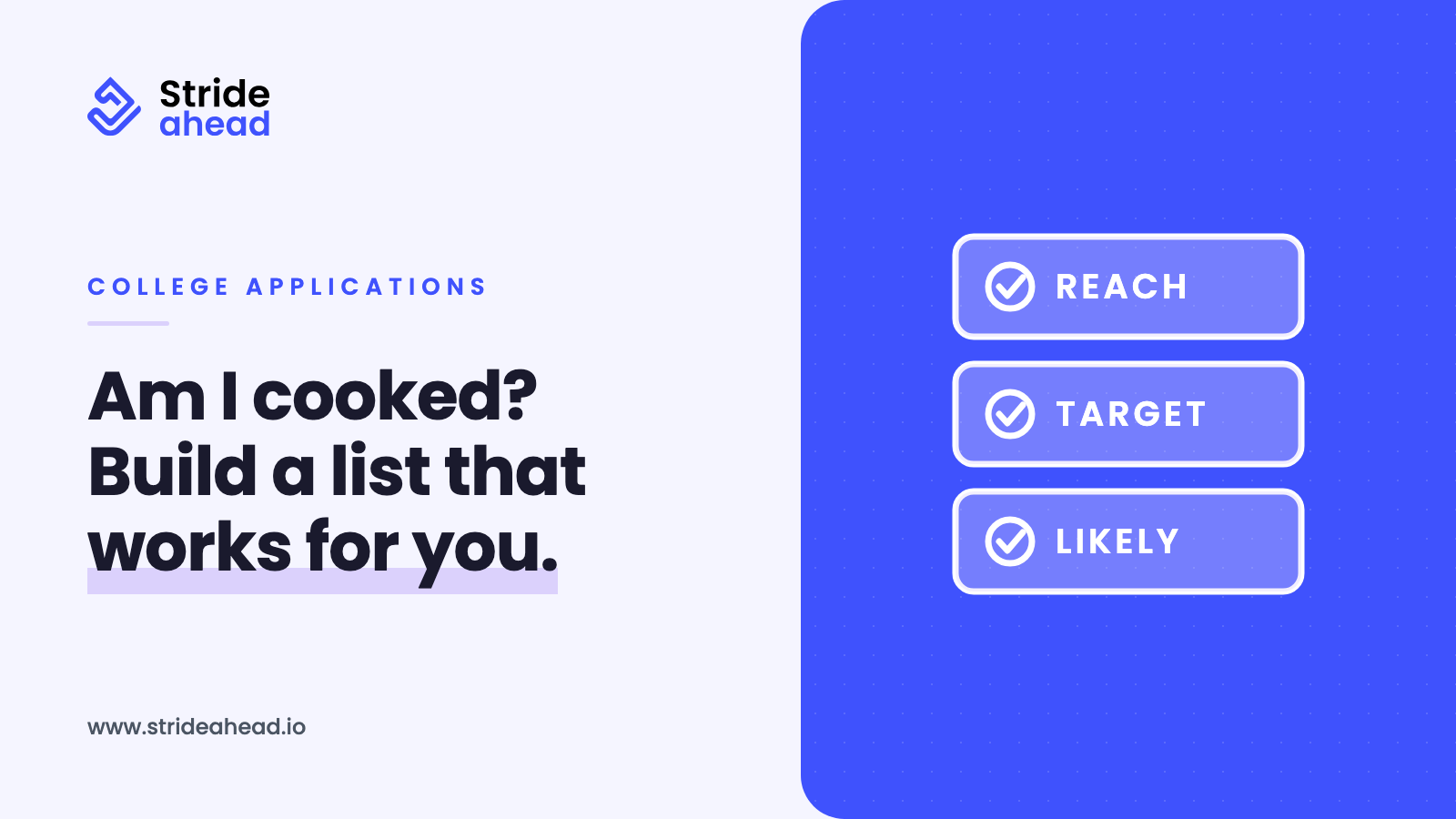
You are very probably not cooked. When an application season goes badly, the problem is usually the list, not the student. People apply to a handful of famous names, panic when a stranger online rates their chances, and forget to include a few places they would genuinely be happy at and are very likely to get into. Fix the list and most of the anxiety goes with it.
Spend ten minutes on a student forum this month and you'll see what I mean. The most-viewed threads on College Confidential right now are "chance me" posts, with titles like "Am I cooked for Cornell?" and "Chance me, I am lowkey fried", each pulling in hundreds of views. Early deadlines have just passed, regular deadlines are close, and the nerves are at their peak.
Why does everyone feel so far behind?
Partly because the numbers really have grown. The Common App's end-of-season report for 2025 to 2026 counted 1,527,328 first-year applicants sending 10,786,782 applications. That's an average of 7.06 schools each, up from 6.79 the year before, according to the Common App. Applicants rose 2%. Applications rose 6%.
Read those two numbers together. Students are applying to more places, which drives admit rates at selective schools down and leaves everyone feeling less safe. When a famous university's admit rate falls, it mostly means more people applied. It does not mean you got weaker.
Should I trust "chance me" replies?
I'd treat them as noise. A stranger sees your GPA, a test score and a list of activities, then guesses. They haven't read your essays or your recommendations. They don't know your school's context, or what the university is looking for this year. At the most selective schools, plenty of applicants with perfect numbers are turned down, so a confident "you're in" or "you're cooked" from an anonymous account is a guess either way.
Forums are great for learning how the process works. They are a terrible place to decide how you feel about yourself.
What counts as a reach, a target and a likely?
A reach is a school where your academic profile sits below or around the middle of the students it admits, or where the admit rate is so low that it's a long shot for everyone. Every highly selective school is a reach, even for very strong applicants.
A target is a school where your grades and scores land in the middle or upper part of its admitted range.
A likely, which people often call a safety, is a school where your profile is clearly above the typical admitted student, the admit rate is high, and your family can afford it.
A healthy list has a few of each. The classic mistake is a list that is all reaches, plus one "safety" the student would hate to attend.
How many colleges should I apply to?
Fewer than you think, if they are the right ones. The average applicant now applies to about seven. Eight to twelve is usually plenty when the list is balanced. Twenty applications with rushed essays often do worse than ten written with care, because each one asks you to explain why that particular school, and readers can tell when you don't know.
How do I make the list fit me and not the rankings?
Begin with what you want from the next four years, then look for schools that offer it.
What do you want to study, or explore? Check each school is strong in it, or flexible enough if you're undecided. How do you learn best: small seminars or big lectures, a city or a campus, close to home or far away? What can your family really afford? Use each school's net price calculator rather than the sticker price, because many "expensive" schools give generous aid. And the question people skip: where would you be glad to go if every other school said no? That school belongs on your list as a likely.
Here's the nice side effect. Students who know what they want write better essays, because "why this school" finally has a real answer.
What should I do once the list is done?
Stop refreshing the forums and put the energy into the applications. Write the essays for your likelies and targets with the same care as your reaches, because those are the schools most likely to say yes. Read each school's own site to find a genuine reason you want to go there, something about a course, a professor or the way students learn, not the ranking. Then let the list do its job. A balanced list is built so that a few rejections don't decide your future.
Is it too late to fix my list?
Usually not. Many schools have regular deadlines in January, and some admit on a rolling basis well into spring. Outside the US, systems like UCAS in the UK and university portals in Canada and Australia run on their own calendars, so check each one. If your list is all reaches right now, add two or three solid targets and likelies this week.
How strong is your profile, really?
Instead of asking strangers, measure your profile against what admissions readers actually look for. Stride Ahead's Profile Gap assessment shows where your profile is strong and where the gaps are, so you can build a list that fits and decide what to work on next. It is free in your Stride Ahead dashboard.