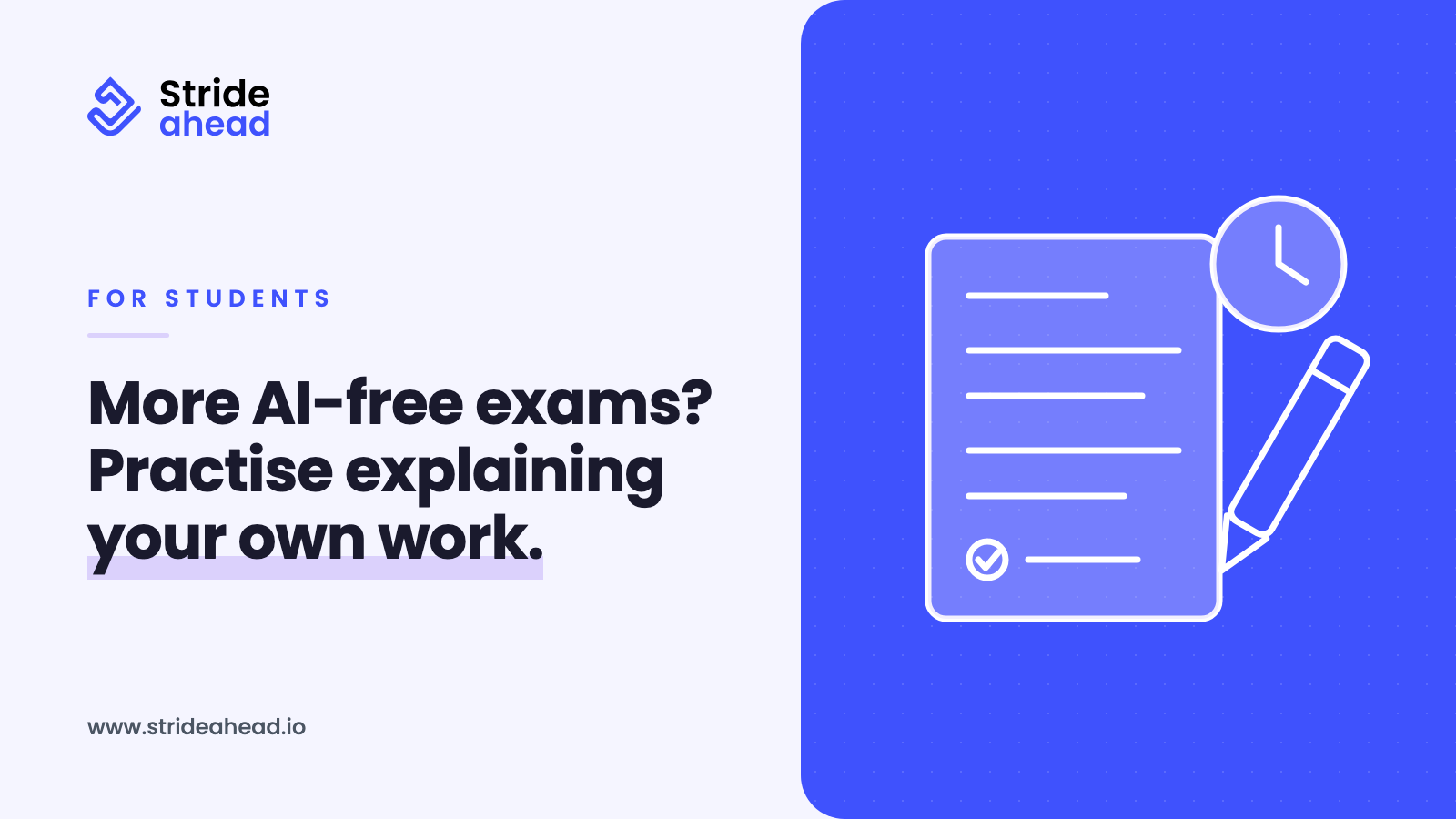
Some are, and more will follow. On 11 November 2026, England's university regulator, the Office for Students, said it will require universities to use assessments that reliably measure what students actually know, and that in many cases this will mean secure, AI-free assessment. If you start university in the next year or two, expect more closed-book exams, presentations, practical tasks and questioning in person, and less weight on essays written at home.
The way to prepare hasn't changed much. One skill just matters more: explaining your own work without a screen in front of you.
The announcement made UK headlines and was posted twice on Hacker News within a day. It landed because students already know the problem. In the research behind it, students described peers who had finished assessments with AI chatbots, sometimes in a few minutes, and received grades similar to students who did the work themselves.
What exactly did England's regulator say about AI and assessment?
It said unsupervised assessments can often be completed to a high standard with AI, and that universities must make sure their assessments measure students' own knowledge and skills.
The Office for Students (OfS) research with Advance HE drew on conversations with over 300 students and staff from more than 120 institutions, held between June and September 2026. That's a set of reported experiences, not a controlled experiment, but its conclusions are blunt. Where assessments are unsupervised, the report says, it is "frequently possible to complete them to a high standard using AI tools without demonstrating the knowledge and skills they are intended to test". It adds that AI detection tools don't consistently and reliably catch it.
In the OfS press release, its director of strategy and delivery, Josh Fleming, called for "far greater use of AI-free assessment". The regulator also said it would hold universities to account, with penalties that can include fines.
It isn't a ban on AI. The same report says students see AI skills as important for their future jobs, and that many get too little training in using AI well.
Which kinds of assessment are likely to grow?
Closed-book exams, presentations, practical assessments and performances are the formats the OfS names as likely to give the most valid measure in many cases.
Look at how one large university already does it. The University of Sydney uses what it calls a two-lane approach. Lane 1 is secure and in person: exams, in-class tests, practical tasks, viva voces, interactive oral assessments and questions after a presentation. Lane 2 is open, where students learn with AI in ways that suit the subject.
I think that's where most universities will end up. AI will be allowed, and even taught, in some tasks. Other tasks will check, face to face, that you understand what you handed in.
Does this matter if I'm not planning to study in England?
Yes. England's regulator is unusually explicit, but the problem it describes exists wherever students have a chatbot on their phone, and Sydney shows a university on another continent reaching a similar answer.
If you're comparing courses in any country, read how each module is assessed. Course pages and module handbooks usually say so. On an open day or in an email to admissions, ask what share of the marks comes from exams, coursework and oral or practical work, and what the AI policy is.
That last question matters. The OfS found students are often unclear about whether, and how, they're allowed to use AI in assessed work.
What is a viva, and why does it make students nervous?
A viva is a conversation in which an examiner asks you questions about your work or a topic to check that you understand it. An interactive oral works in a similar way.
It makes people nervous because you can't edit your answer. You can, however, prepare for it, and the preparation is mostly practice at thinking out loud.
If you have a disability, an anxiety condition or another reason that live questioning is harder for you, ask about adjustments early. The OfS report says assessment has to be accessible as well as robust, and it notes that AI tools may particularly help some disabled and neurodivergent students and students studying in a second language. Those students lose the most if new formats are designed carelessly, so speak up.
How should I prepare for more closed-book and oral assessment?
Practise pulling what you know out of your head, spread over time, because that's what learning research supports most strongly.
A major 2013 review of ten common study techniques by John Dunlosky and colleagues gave its highest rating to practice testing and spacing your study out, and rated highlighting, rereading and summarising as low utility. A 2017 meta-analysis of practice testing found that practice tests produced more learning than restudying and every other comparison condition it examined.
In practice, close your notes and write down everything you remember about a topic, then check what you missed. Explain a concept out loud to a friend, a parent or an empty room, and notice where you start waffling. That's the gap. Do past papers under timed conditions. When you practise a presentation, get someone to ask you questions you didn't plan for.
For written coursework that may be followed by questions, keep your working: notes, drafts and the sources you actually read. If you can explain why you made each choice, an oral check is a chance to show it.
Should I stop using AI for studying?
No. Use it to test yourself rather than to do the thinking for you.
The OfS report puts it well: whether AI improves or weakens learning depends on how it's used. Using it to replace reading, research or problem solving skips the productive struggle that builds the skill. Ask a chatbot to write ten practice questions on a topic, then answer them with the chat closed. Ask it to find the weakest point in an explanation you wrote yourself. We wrote more about this in Is AI helping you learn, or just helping you finish your homework?
What can I do now, while I'm still at school?
Start treating anything you write as something you might be asked to defend. If a teacher asked you about it tomorrow, could you explain how you got there? Make that your test before you submit anything.
Take the chances you already have to speak. Class discussions, presentations, debates and model UN all count as practice for a viva, even if they don't feel like it. If you dread them, that's useful information, and it's much cheaper to work on at 16 than in a first-year exam hall.
Build the habit of timed recall now too, by hand or on a locked-down computer, whichever your exams use. Students who've mostly typed with help a click away often find the first closed-book exam a shock. It doesn't have to be.
How ready are you for the way universities now assess?
If you're heading to university, at home or abroad, the Stride Ahead Global Readiness Index asks about things this shift rewards: presenting to a group, writing clearly, planning a project over several weeks and researching from more than one source. Use your result to choose one skill to practise this term, not as a verdict.
Sources
- Office for Students and Advance HE, Making AI work for students: reflections on institutional practice, 11 November 2026.
- Office for Students, Universities should help students develop AI skills while protecting confidence in degrees, press release, 11 November 2026.
- Hacker News, discussion of the regulator's warning on AI and coursework, 12 November 2026; audience attention.
- University of Sydney, Frequently asked questions about the two-lane approach to assessment in the age of AI, first published July 2024, updated April 2026.
- Dunlosky, J. et al., Improving Students' Learning With Effective Learning Techniques, Psychological Science in the Public Interest, 2013.
- Adesope, O. O., Trevisan, D. A. and Sundararajan, N., Rethinking the Use of Tests: A Meta-Analysis of Practice Testing, Review of Educational Research, 2017.