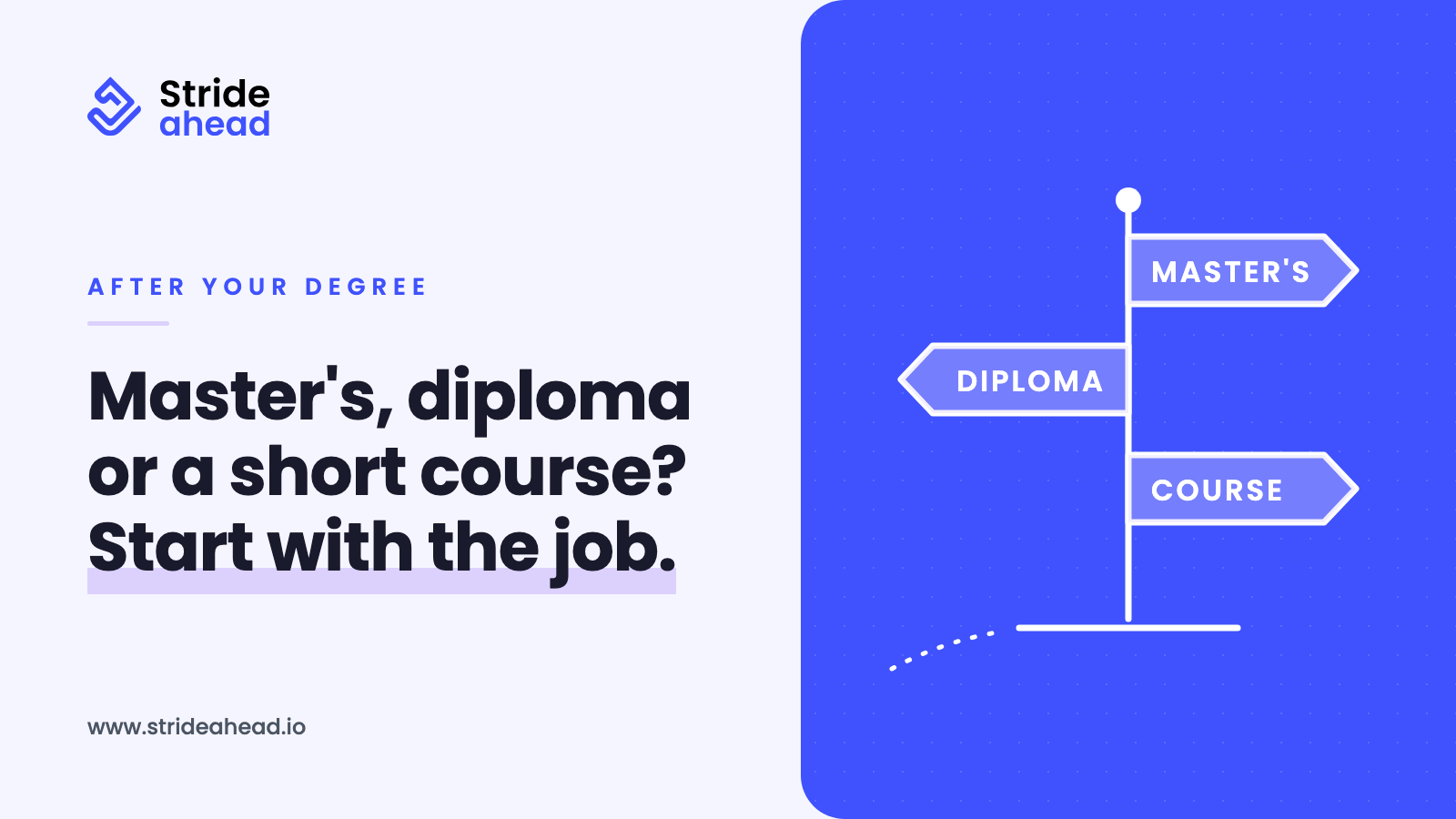
Don't choose a course yet. Choose two or three jobs you'd be glad to be doing in three years, find out what people in those jobs actually needed to get there, and then take the smallest route that closes the gap. Sometimes that's a master's. Often it's a postgraduate certificate, a short course that ends in work you can show, or a year in a job first.
If you've finished your degree and still feel lost, you have a lot of company. The Federal Reserve Bank of New York's latest figures show that 42.5% of recent US graduates were underemployed in the third quarter of 2026, meaning they worked in jobs that don't usually need a degree. A 2024 study by Strada and the Burning Glass Institute found that only about half of bachelor's graduates land a job that needs their degree within a year. That isn't a personal failing. It's the most common story there is.
When the first job disappoints, a master's starts to look like a clean restart. It can be one. It can also be an expensive way to put off the same decision for a year.
Should you do a master's if you don't know what you want?
No. A master's is a tool for reaching a particular job, and it's a poor way to buy time.
The numbers are blunt. An analysis of US graduate programmes by the Foundation for Research on Equal Opportunity found that 40% of master's degrees don't produce a positive financial return once fees and the earnings you give up while studying are counted. Most master's programmes in computer science, engineering and nursing paid off well. Arts and humanities programmes rarely did, and even the median MBA came out negative.
So "is a master's worth it?" is the wrong question. Ask whether this master's is worth it for this job.
What are the steps to choose your next course?
There's an order to this, and skipping ahead is where the money gets wasted.
Name two or three jobs, not courses.
If you can't name any yet, spend a few weeks exploring careers before you open a single prospectus.
Read 15 to 20 real job adverts for each.
Note which qualifications are required, which are only preferred, and which skills keep coming up.
Talk to three people doing the job.
Ask what they'd tell someone starting from where you are.
Name the gap.
It's usually a qualification, a skill or experience.
Pick the smallest route that closes it.
A master's or diploma for a required qualification. A certificate or short course that ends in real work for a skill. A job in or near the field for experience.
Check the programme and the money before you apply.
Check the programme and the money before you apply.
How do you find out what a job really requires?
Read the adverts before the brochures, then check what you read with people who do the work.
Patterns show up quickly. Some jobs list a licence or a specific postgraduate qualification every single time: teaching, clinical psychology, social work, many health professions and some routes into law. For those, the qualification isn't optional, and your job is finding the best-value programme. Other adverts ask for a degree "or equivalent experience" and spend the rest of the page on tools and evidence of work.
Don't read too much into "or equivalent". Many employers have announced they're dropping degree requirements, but a 2024 study by Harvard Business School and the Burning Glass Institute found that for most of them, lasting changes in who they actually hire have been hard to find. Assume the qualification still counts for a lot unless the people you speak to tell you otherwise.
Those conversations matter as much as the adverts. People in the job can tell you which credentials got them interviews and which ones nobody asked about. LinkedIn and your university's alumni network are the easiest places to find them. Keep the message short and specific: you're asking for ten minutes, not a job.
What's the difference between a master's, a postgraduate diploma and a certificate?
Mostly size. They're steps on the same ladder.
In the UK, academic credit is counted in units of about 10 hours of learning. The Quality Assurance Agency's guide for students describes a postgraduate certificate of 60 credits and a master's of 180, and a postgraduate diploma usually sits between them at 120. A master's normally ends with a dissertation or a major project; the certificate and diploma usually don't. Australia, Canada and many other countries use similar ladders, often called graduate certificates and graduate diplomas.
The useful part is that the steps can stack. The QAA's own example follows a part-time student who earned a postgraduate certificate after the first year, took a year off, and later completed the full master's. If you're unsure about a field, a certificate is a far cheaper test than a full degree. Ask the university whether its certificate credits count towards the master's.
When is a master's worth the money?
When the job requires it, when it's built for people changing field, or when the earnings in that field clearly justify the cost.
The first case needs no debate.
The second is the "conversion" master's, designed for graduates of unrelated subjects. England's Office for Students, for example, funded AI and data science conversion courses so that graduates from a wide range of disciplines could move into those jobs. Law and psychology have well-established conversion routes too.
The third needs care. On average, postgraduates do earn more. In the US, people whose highest qualification was a master's had median weekly earnings of $1,876 in 2025, compared with $1,578 for a bachelor's. In England, working-age postgraduates had a median salary of £47,000 in 2024, against £42,000 for graduates. But the Department for Education itself warns that those figures don't account for differences such as prior grades, and an average hides the programmes that never pay back. Look up your field and your programme, not the national average.
Can a short course get you a better job without another degree?
Yes, in fields that hire on proof you can show, and rarely where a credential is the gatekeeper.
Data analysis, design, software, marketing and many digital roles let you show what you can do: a portfolio, a set of projects, a piece of work for a real organisation. There, a focused course plus three solid projects can beat a year of study at a fraction of the cost. Where adverts keep listing a licence or a degree, no short course will stand in for it, however good it is.
Most short courses have no outside quality check, so judge one by what its graduates can show you, not by its certificate. If it can't point you to past students' work, keep looking.
How do you check a programme before you pay?
Ask for outcomes, check the institution can award what it promises, and walk away from anything that guarantees a job.
Ask the department what share of last year's graduates were working in a related job six months after finishing, what they earned, and how many graduates answered that survey. A programme that can't or won't tell you is still telling you something. In the US, the government's College Scorecard shows earnings and debt for many master's programmes, one programme at a time.
Then check recognition. In the UK you can check whether a university or college can award a degree, and most countries keep a similar public register. Promises of guaranteed placement, pressure to pay a deposit this week, or a name suspiciously close to a famous university are all reasons to leave. And if two programmes share a title, compare their modules and assessments, not the name.
What can you do this week?
Write down your jobs, start counting adverts and send three short messages to people in those roles. Within a month you should know, for each job, whether the gap is a qualification, a skill or experience. That answer will narrow your options more than any ranking table.
If you're aiming for a programme that starts next autumn, look at funding deadlines before course deadlines, because scholarships often close first. And if a year of work would teach you what you want, take it. Some employers will help pay for part-time study once you've proved yourself.
If you still can't name a job you'd want, that's the real task. Don't pay a university to postpone it.
Which gap are you actually closing?
Before you spend on a course, measure where you stand. The Stride Ahead Skill Gap Index compares your current skills with what the role you want demands, so you can see whether you need a few skills or a whole qualification. Use the result to choose your route, not as a verdict on you.
Sources
- Federal Reserve Bank of New York, The Labor Market for Recent College Graduates, data for Q3 2026, checked 16 Nov 2026
- Strada Education Foundation and Burning Glass Institute, Talent Disrupted: College Graduates, Underemployment, and the Way Forward, February 2024
- Preston Cooper, Foundation for Research on Equal Opportunity, Is Grad School Worth It? A Comprehensive Return on Investment Analysis, 2021
- Harvard Business School Project on Managing the Future of Work and Burning Glass Institute, Skills-Based Hiring: The Long Road from Pronouncements to Practice, February 2024
- Quality Assurance Agency for Higher Education, What is credit? A guide for students
- Office for Students, Postgraduate conversion courses in data science and artificial intelligence
- US Bureau of Labor Statistics, Unemployment rates and earnings by educational attainment, 2025 data
- Department for Education (England), Graduate labour market statistics, calendar year 2024
- US Department of Education, College Scorecard
- GOV.UK, Check if your university or college can award a degree